Sunday, 16 August 2020

Getting back in the saddle

It is impossible to describe what it feels like to lose a child. Alice's illness with a brain tumour was the dominant presence in my life all the way through my journey back to art school and establishing my practice. Her death had been approaching relentlessly for a decade and everything else in our lives happened around the edges of that. All my artworks, including the public artwork March For Optimism, and the ongoing distributive woodcut 'I'm Glad You're Alive!' are all responses to the world that squeezed out round the edges of the fact of Alice's impending death. 

Alice died in the Duchess of Kent Hospice, Reading on 6th June 2019. Over a year later Liz and I, and her brother Joe, carry the loss daily. It is like learning to live in a home with the back-wall blasted away. We are functioning and doing things day to day when they seem possible. I returned to my teaching job at Winchester School of Art last October and in my more lucid moments have probably contributed a little to my students' recent degree successes. I'm immensely proud of all of them.

Artistic output dwindled to a trickle over the last couple of years, as the creative urge has been at a low ebb. But the stuff that squeezes out around the edges has included my book, A Walk For Stanley, published a month after Alice's death and some paintings and drawings which have found appreciative audiences (buyers!)

During the Covid-19 Lockdown all teaching, tutorial and assessment activity was conducted online. I wanted to make something to encourage my students so I created this simple woodcut:


I made an edition of 110, giving them to my students as part of an art exchange and selling the excess for £15 each. I passed all the proceeds to two local charities: Reading Refugee Support Group and Sue Ryder, Duchess of Kent Hospice. Both charities are close to our hearts because Alice volunteered for RRSG and was cared for at DOK for the last six weeks of her life. The sales raised £480 each for the charities. 

Another nationwide response to the Covid-19 crisis was #portraitsfornhsheroes, initiated by portrait painter Thomas Croft. Artists offered free portraits for NHS workers, who were putting their lives on the line daily to tackle the impact of the pandemic. I ended up doing two such portraits. Mine were made as woodcuts and I think the recipients were happy with the results. This one is Kerry, a trainee pharmacist (and Joy Division fan). 


A third lockdown project came in the form of an online auction organised by ArtAgainstCovid in the North West. My friend the artist and curator Kezia Davies was involved in organising this and I was happy to donate a print. It was bought by a collector in New York who did well to get this for the bargain price of £70.


So Lockdown has seen me getting 'back in the saddle', getting back to the studio at OpenHand OpenSpace. I am making new work and developing plans for future projects - watch this space for more news about them soon. 

Sunday, 24 June 2018

Only The Sunny Hours: contemporary photography with a Brownie 127

I put four photos into an exhibition curated by Cally Trench. Only The Sunny Hours; contemporary photography with a KODAK Brownie 127.  At OpenHand OpenSpace, Reading, 20-24 June 2018.

I'm very grateful to Cally for including me in the project.  I haven’t often used photography in my practice and it has been an interesting experiment for me. 

Greenham Common: towards the control tower - Dartford Warbler [Peter Driver 2018]
My four photos were made on Greenham Common. I am fascinated by the place, its history and what it has become.  Because of its history and particularly the activism of the Women’s Peace Camp it has been used as subject matter by a number of contemporary artists over the last twenty years or more [for instance Margaret Harrison, and Jane and Louise Wilson's ‘Gamma’].  My work involves making drawings, prints and photographs on the site.  And thanks to Cally I have discovered something about the quality of the photos from a Brownie 127 that adds to the poetic sensibility of the work.

People of my generation and older will recall that during the Cold War, in the 1980s, when NATO powers were locked in a nuclear arms race with the Soviet Union, the British Government agreed to site United States tactical inter-continental nuclear weapons in Britain. From 1983, over ninety ground-launched Cruise Missiles, with nuclear warheads, were sited at RAF Greenham Common, which was used by the United States Air Force. 

Between 1981 and 2000 a Women’s Peace Camp was maintained at Greenham Common by a changing cast of many thousands of women. They were protesting against siting nuclear missiles on the base.  Some of the women camped around the perimeter long-term (the longest-serving protesters camped there for nineteen years); others visited as often as they could to offer support.

Throughout the duration of the peace camp women were routinely evicted, assaulted by police and military, abused by passers-by, arrested, imprisoned, and vilified in the press.  Undeterred, they maintained their protest.  In December 1982, 30,000 women came together to surround the entire base in a hand-holding chain entitled ‘embrace the base’.  The women staged a continuous range of non-violent actions, chaining themselves to the fences, blockading the entrances, cutting through the fences and invading the silos where the missiles were stored. 

Greenham Common: missile bunkers - Ring Ouzel [Peter Driver 2018]
There are many documentary sources for the study of the Greenham phenomenon, including Sasha Roseneil’s sociological study, Disarming Patriarchy: feminism and political action at Greenham (Open University, 1995), and the film ‘Carry Greenham Home’, by Beeban Kidron and Amanda Richardson.

Many people, probably the majority of people at the time, disagreed with their stance and certainly disapproved of their tactics. But, love them or loathe them, the Women’s Peace Camp stands as one of the most significant acts of durational dissent in British history.  Their achievement was to bring radical feminist direct action and civil disobedience into the public discourse. Greenham left a global legacy of activism, inspiring people and especially women, worldwide to new forms of critical engagement, protest and direct action. The Peace Camp and its repertoire of creative forms of resistance became the inspiration for later campaigns - including the Twyford Down and Newbury Bypass  environmental protests, and the Occupy Movement.

The Cruise missiles were eventually removed in 1991 as part of arms reduction agreements between Gorbachev and the West, and the base was decommissioned.  It isn't possible to demonstrate any causal link between the protests and the decommissioning but with hindsight, public opinion about nuclear weapons has changed and has been informed by the courageous protests at Greenham. 

Greenham Common: remnant of the fence - Woodlark [Peter Driver 2018]
The commons were officially re-opened to the public in 2000. The two-mile length of concrete runway was broken up and the huge site has now largely reverted to natural heathland habitat. It provides a haven for wildlife alongside cyclists, joggers, grazing cattle, and dog-walkers. Several endangered bird species have returned to nest on the site.

About a dozen pairs of Woodlark are now present.  Wheatear and Ring Ouzel stop-over on passage to and from their upland breeding grounds. And for me, the most notable returnee is the Dartford Warbler.  A species that was on the brink of extinction in Britain when I became a birdwatcher in the late Sixties, at the age of eight. 

By this time last year numbers of Dartford Warblers had risen to over three thousand pairs in Britain, with eleven territories on the Common – a massive success story.  Unfortunately, this year, the picture is different. The horrendous cold snap, dubbed ‘The Beast from The East’ almost wiped out some local populations of Dartford Warblers.  The harsh weather came right at the end of the winter when birds were on the brink of perishing from starvation.  Repeated surveys on Greenham Common have found only one breeding pair this year.  Personally I have seen one bird all year.  It’s a similar picture on the Thames Basin Heaths on the Berkshire/Surrey border.  This is a major set-back from which there is just a glimmer of hope for another slow recovery.

So my work holds together these two themes of the social-historical significance of the site and its current ecological importance.  I see the act of birdwatching and drawing on the site as a way of responding to what it once was, and now is.

I think it's important to recognise a risk for my work that I could be co-opting the history and the activism of those fierce and defiant women in an effort to make my work seem more radical or interesting, by association.  But the urgency and power of direct action will always be more discomforting and demanding of a response than any artwork in a gallery.

My work alludes to the traces and memories of things that are no longer there and the fact of my presence to apprehend that absence.  There is a kind of poetic dissonance created between the different times and their different uses of the site.
The work also carries my memory of living under the threat of nuclear annihilation  I grew up in the ground-zero zone around RAF Mildenhall in East Anglia, and the nuclear threat was as an ever-present, but generally unacknowledged backdrop to my childhood and adolescence.  Those memories remain part of my relationship with Greenham Common. In a way, this makes the act of birding on the site a celebration of human survival just as much as it celebrates the return of the Dartford Warbler.  I am interested in presenting the social history, in a tangential rather than didactic way, reflecting on it, inviting others to do the same and in their own ways, to consider what implications there might be for their own lives and comforts.

Greenham Common: fire plane - Wheatear [Peter Driver 2018]

I have great respect for the Women’s Peace Camp movement that stood opposed to an unassailable global power at Greenham.  I recognise my work's inadequacy to address such issues, or to affect any change. But I hope it can point towards what can be achieved by people united in common cause and collective action.  If all else fails it could just highlight the changing fortunes of the bird populations, as a gesture of helplessness.

If art is able to achieve anything in the world then I hope the work can operate as a small beacon for the forms of resistance that we're all going to need in the impending future.


Sunday, 10 September 2017

'Imagined Futures' at K6 Gallery 1 September - 1 December 2017

I was delighted to be approached by K6 Gallery,Southampton back in June, about showing some work in their unique public exhibition space. K6 Gallery is located in two decommissioned K6 model telephone kiosks in the centre of Southampton. Here's a link to the gallery webpage: http://k6gallery.com/exhibitions


photo: Kate Aries


This show is the product of a focussed period of work. Everything was made specifically for this site to work within the physical parameters of the phone boxes but also using the windows to engage people passing by.

Photo: Kate Aries

I often find it difficult talking and writing about my work - and I feel that my works should be able to speak for themselves. I am interested in the idea that the viewer is a participant in the creation of meaning. The work should be able to stand alone without me there to explain it. Explanation limits the power of the work to create new meanings.

Photo: Kate Aries
Unusually for me, this collection of work is clearly subject-specific in its content. It addresses a particular area of public policy.

Now I don't claim to be a political artist. I am not necessarily in favour of artists trying to promote a specific 'message' because that can be very problematic and potentially fatal for the work. But the very interesting artist Susan Hiller has said - " my work isn't about specific political or ethical positions, yet like all art it is the result of them and allows or even provokes the formation of new positions". I think it is interesting to consider how all art is the result of political and ethical positions. One way to consider any art work is to ask whether it supports the status quo - the current hegemonic settlement - or if it is agitating in some way for new perspectives.


The work addresses the subject of primary education policy.  I wouldn't claim to be an expert on this subject or to have any more knowledge than anyone who reads the newspapers or takes a general interest in public life.  But it is something I am concerned about. I think the signs are that we as a society are failing our children by imposing on them a curriculum that is skewed towards what is measurable. This in turn feeds a rigid and highly stressful testing and assessment regime. In a survey of primary school leaders earlier this year, 80% of them reported increased levels of stress, anxiety and mental health issues among their pupils. They attributed this increase to the national testing regime.


I am equally frustrated that the main opposition parties are offering no alternative and that their education policies seem to have been reduced to throwing free food - often inedible food - at children rather than addressing the fundamental problems with the curriculum, inspection and assessment which have been raised by the teachers unions.

The concept of Imagined Futures comes from the simple premise that everything in our environment has its origin in somebody's imagination (particularly so for the theists among us, but for everyone else this is true at least of our human-made environment). Imagination is the genesis of every progressive idea, invention, design and object we encounter.  As such the present world is the product of multiple imaginations and the same is true of the potential future world.  My point is that if education policy restricts and withers the scope of children's imaginative play, that in turn restricts and withers the kind of world those children will create, produce or endure - and their role in it.

Photo: Kate Aries


There is a stack of free woodcut prints in the show. It's a limited edition of 400 prints and I hope visitors will all take one. The print incorporates the text 'Imagine Better', which I hope carries something of the ideas in a way that is open to different interpretations - it might suggest that imagination can be improved with practice; and that we might imagine a better way of doing things.


Susan Hiller suggests that as artists we are involved in the social construction of the visible world. It is what we do. And we are able as artists, in our small way, to change how things are seen or to provoke new thinking.  If there is a goal in making this body of work then I think that is it - and what I have produced probably misses it. There is a kind of knowing tension at play between contributing to a public debate and the pathetic impotence of shouting inside two phone boxes. But whether it's impotent or not, I am really grateful for the opportunity to say something.

I am grateful to Liz Driver, my wife and partner in the production of the four banners in the show. She did all the practical bits of the banners that involve skill with a sewing machine and also helped me shape my ideas through discussion of the content of the show.

K6 Gallery is open all day every day and my show runs until 1 December 2017. The curators  are Alex Batten and Eloise Rose and they are both a joy to work with. All the prints are limited edition woodcuts on Somerset Satin. They are for sale on the K6 website while stocks last: http://k6gallery.com/shop

After the p.v. launch on 1 September.


Friday, 3 April 2015

Hit the North

One of the best things about art school is that you get to know and love a bunch of new, exciting and creative people who form a network for sharing ideas, mutual support and collaboration long after the course finishes. One of my best friends and collaborators from art school, Elly Langlois,  is mid-way through a six-month residency at In-Situ, based in Pendle District in Lancashire. Last week, I teamed up with another friend, Guy Blundall, to go and spend a few days with Elly in The North. 

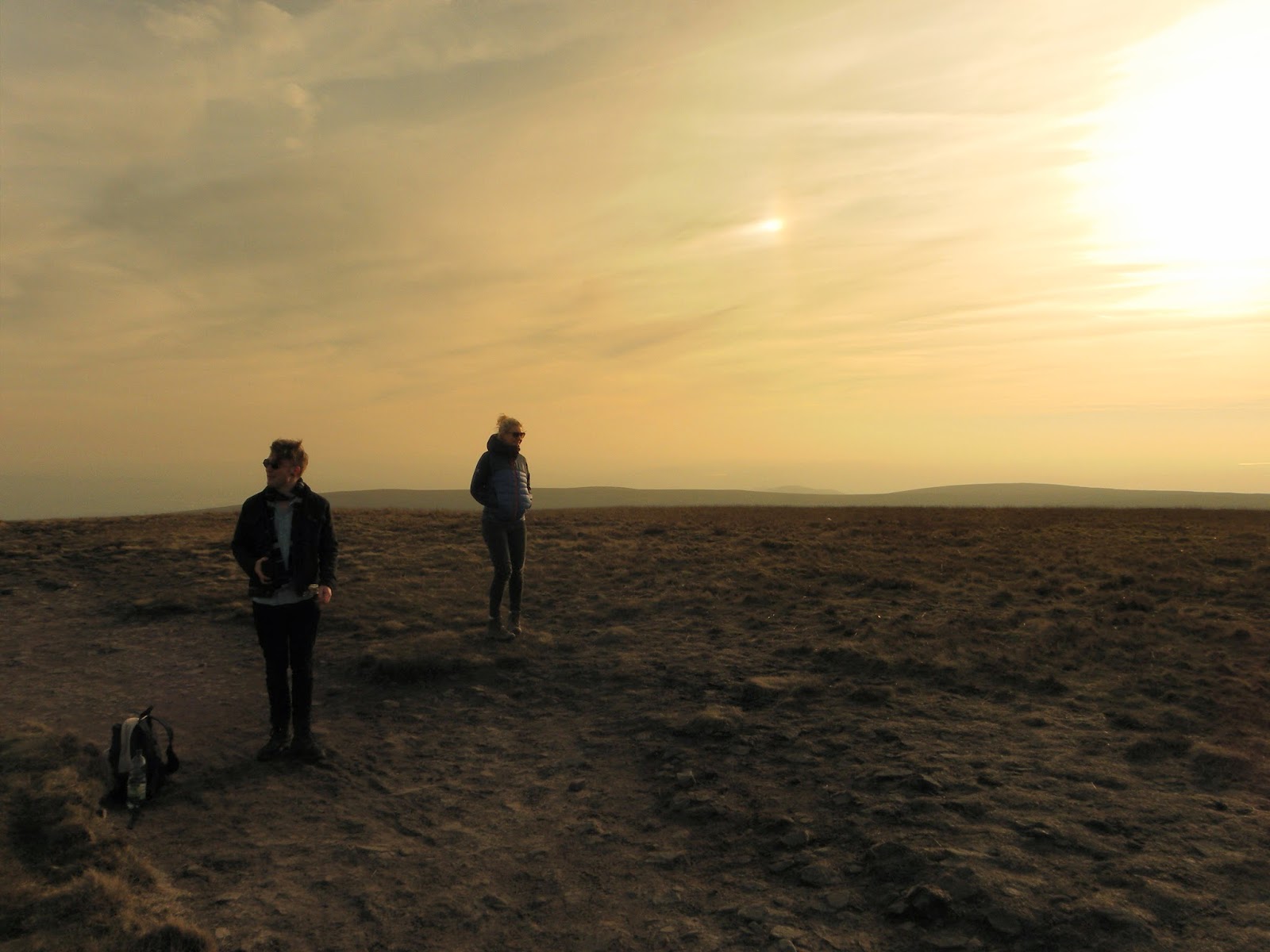
On arrival, we headed straight up Pendle Hill to make the most of the Sunday afternoon sunshine: 


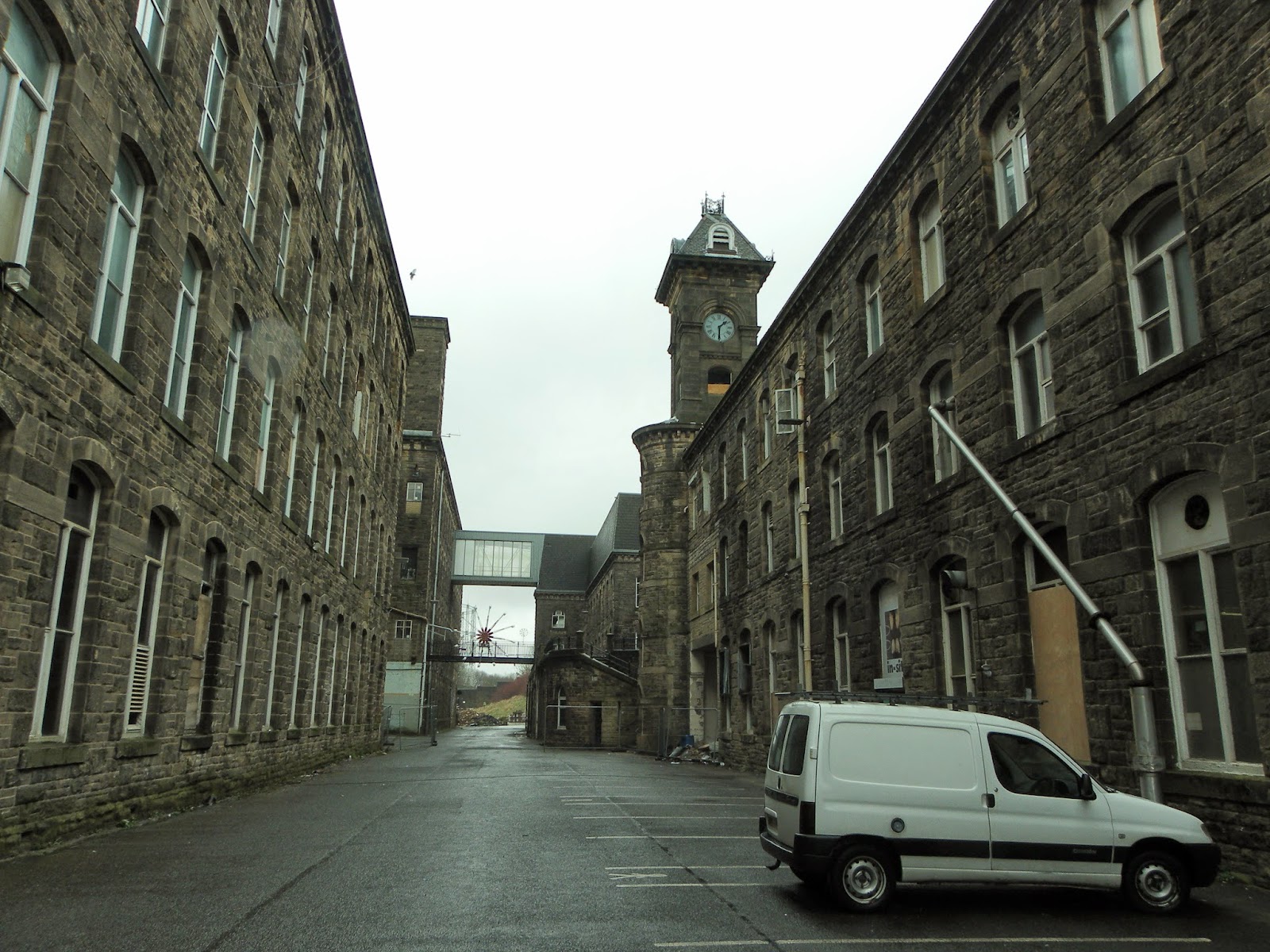
The In-Situ ethos is based on the concept of artists being embedded in their local community, being 'in the mix' and being just part of ordinary community life like the baker or the newsagent. Artists don't have all the answers but they have a contribution to make. In-Situ has a space/office/exhibition area in Brierfield Library and is also located in Brierfield Mill. They offer funded artist residencies of various lengths for artists to come and work in the area. They don't 'deliver community art' or 'run community workshops' or 'work in community settings' - they just do their work as artists, within the  community they are part of. I find this really refreshing.


Elly had invited us up to be part of a 'test run' for a project she is planning for later in the year at Brierfield Mill.  The Mill is immense. There are two huge buildings, each with four floors. At its height there were thousands of cotton looms running here and when it finally closed down in 2006 it was a severe blow to local employment. 

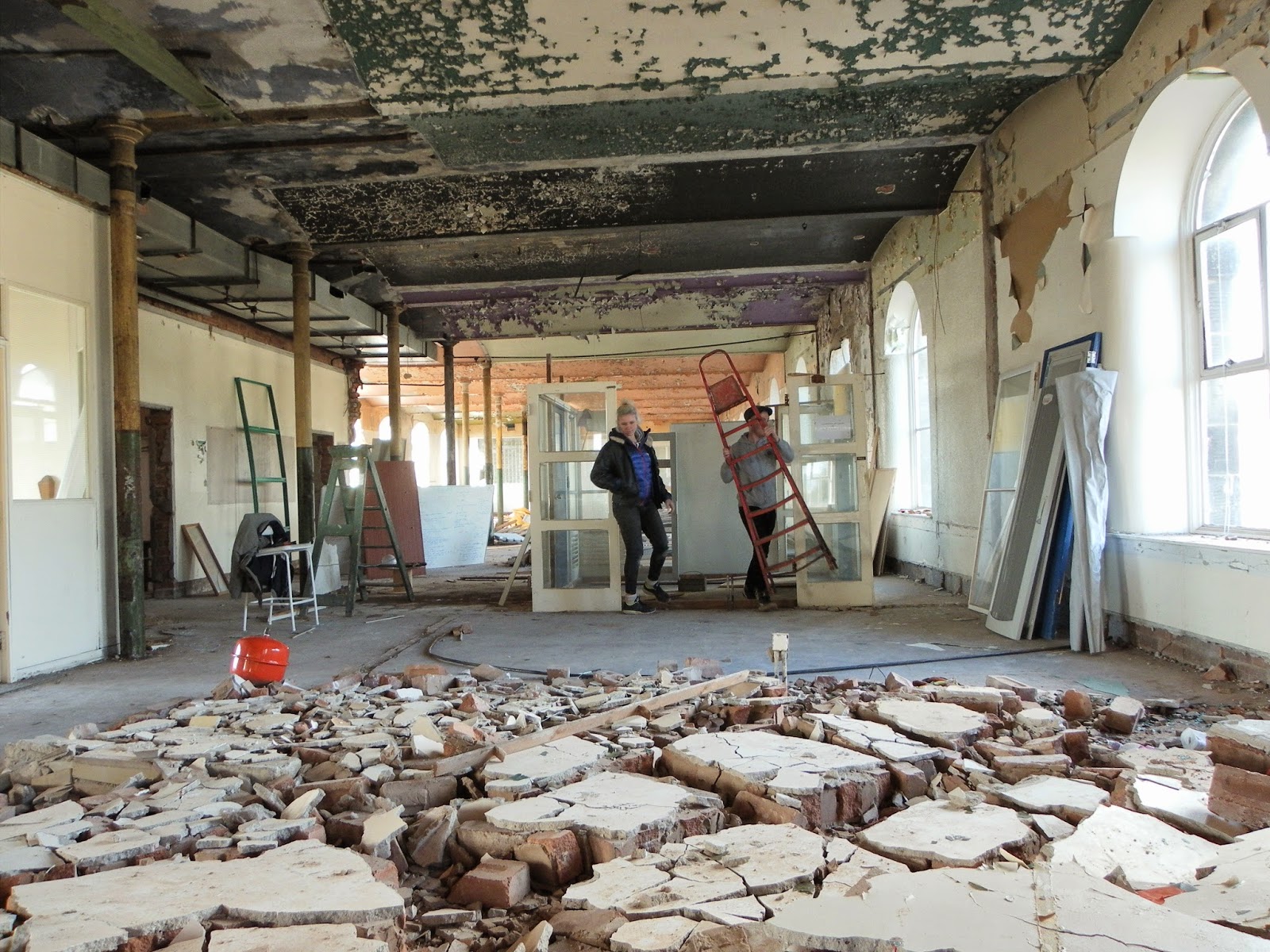
Five of us spent a morning just exploring all the spaces in the mill. 


Red shoe installation at Brierfield Mill - Elina Chavet


Then in the afternoon we chose one space and worked collaboratively to make something. The room was massive, with a twelve-second echo. Jamie, one of our number started working with the constant rainwater drips which were a feature of the room. (The gigantic roof sheds about 20 tonnes of rainwater a day, on average). By setting up objects under each drip, the space was soon filled with an orchestra of raindrops all at different pitches and timings. It was quite magical. We also used objects and feet to print/paint rainwater patterns on the vast concrete floor and make sound recordings.


In the next room, Jamie and I found a sheet of plastic film and made a quite traditional drawing with Posca pens. 


Rain-powered battery-charging turbine made by Paul the resident genius.
A collection of all the keys found laying around Brierfield Mill after it had been abandoned. 

At the end of the day we retired to 'The Shop' in Nelson, where we discussed our impressions of the place, our reflections on the activities of the day - and filled an A1 sheet with ideas of what we would like to do with the place the next day. 

By a democratic process involving each ticking our five favourite ideas, we settled on 'building a house' as our main project for the next two days.  And so we did. Using the enormous amount of scrap materials laying about in the derelict mill, a couple of hammers and a few nails, we constructed a house within the mill. 


After a day we had four walls and a door in place. I had to leave the next morning but the rest of the team managed to get the roof on and complete the house.


Reflecting on the project, I was trying to reconcile what we had done together with my practice as an artist. Was this art? Did it matter if it was art, or not? Had we built a microcosm of the role of art in late-capitalist society? If the mill represent the crumbling ruins of a manufacturing-based economy did our intervention represent artists' contribution - making something new out of the rejected materials of a wasteful society, or maintaining cultural output, like the orchestra playing while the Titanic sank?

I am not particularly interested in whether or not it was a work of art. It was an experience and we were the audience and collaborators in bringing something into existence. Maybe we just spent two days playing at making dens. We also spent two days getting to know and trust each other, building relationships that will still stand once the mill is regenerated and the 'house' is no more. We developed a process and way of working. We exchanged ideas and experiences, explored our motivations for making art and for being in this place at this time. We grew to love Brierfield, and In-Situ, and ate a lot of amazing curries. It was an experience I will never forget. Bring on the next project.